Robotic assistants are moving from science fiction into your daily routine. From vacuuming floors to managing smart home devices, these machines are already reshaping how we handle chores, safety, and even eldercare. Understanding what’s next helps you prepare for a future where automation supports—not replaces—your daily decisions.
This article explores the future of robotic assistants in everyday life, covering practical advances in AI, affordability, and real-world use cases. You’ll learn which tasks robots will master next, how to evaluate them, and what steps to take today to benefit safely and confidently.
Introduction
Robotic assistants have moved from science fiction into the early stages of everyday reality. You may already encounter them as robot vacuums that map your living room, delivery bots that roll along city sidewalks, or voice assistants that control your lights and calendars. The next decade will bring more capable machines into homes, workplaces, hospitals, and schools. This article explores The Future of Robotic Assistants in Everyday Life with clear, practical guidance so you can understand what is coming, separate useful signal from hype, and prepare for the changes ahead.
Understanding the fundamentals of The Future of Robotic Assistants in Everyday Life helps you make informed decisions. Whether you are a homeowner considering your first service robot, a manager evaluating automation, or simply a curious reader, reliable information and consistent habits lead to better long-term outcomes. The goal here is not to predict every product release, but to give you a durable framework you can apply as the technology evolves.
Key Concepts
Before you can evaluate any specific robot, you need a shared vocabulary. These core concepts appear again and again in product specs, news stories, and policy debates.
- Embodiment: A robotic assistant has a physical body that senses and acts on the world. This distinguishes it from purely software agents like chatbots. Embodiment brings both capability (it can move objects) and constraint (it must navigate real spaces).
- Autonomy levels: Robots range from fully teleoperated (a human controls every move) to fully autonomous. Most consumer assistants today operate at partial autonomy — they handle routine tasks and ask for help when uncertain.
- Perception stack: Cameras, lidar, microphones, and touch sensors feed data into software that builds a model of the environment. Better perception means fewer collisions and more reliable task completion.
- Manipulation: The ability to grasp and move objects is the hardest problem in robotics. Simple grippers work for picking up cups; folding laundry or assembling furniture remains a research frontier.
- Human-robot interaction (HRI): How people and robots communicate — through voice, gesture, screens, or physical movement. Good HRI design reduces frustration and builds trust.
- Edge vs. cloud processing: Some computation happens on the robot itself (fast, private, limited) while some happens in remote data centers (powerful, but dependent on connectivity). The balance affects privacy, latency, and cost.
Reliable information about these concepts keeps you from being swayed by marketing language. When a company claims its robot is “AI-powered,” ask which autonomy level it actually achieves and what happens when the network drops.
Deep Dive
The future of robotic assistants will unfold unevenly. Some environments are easier to automate than others, and progress will follow those gradients.
Homes
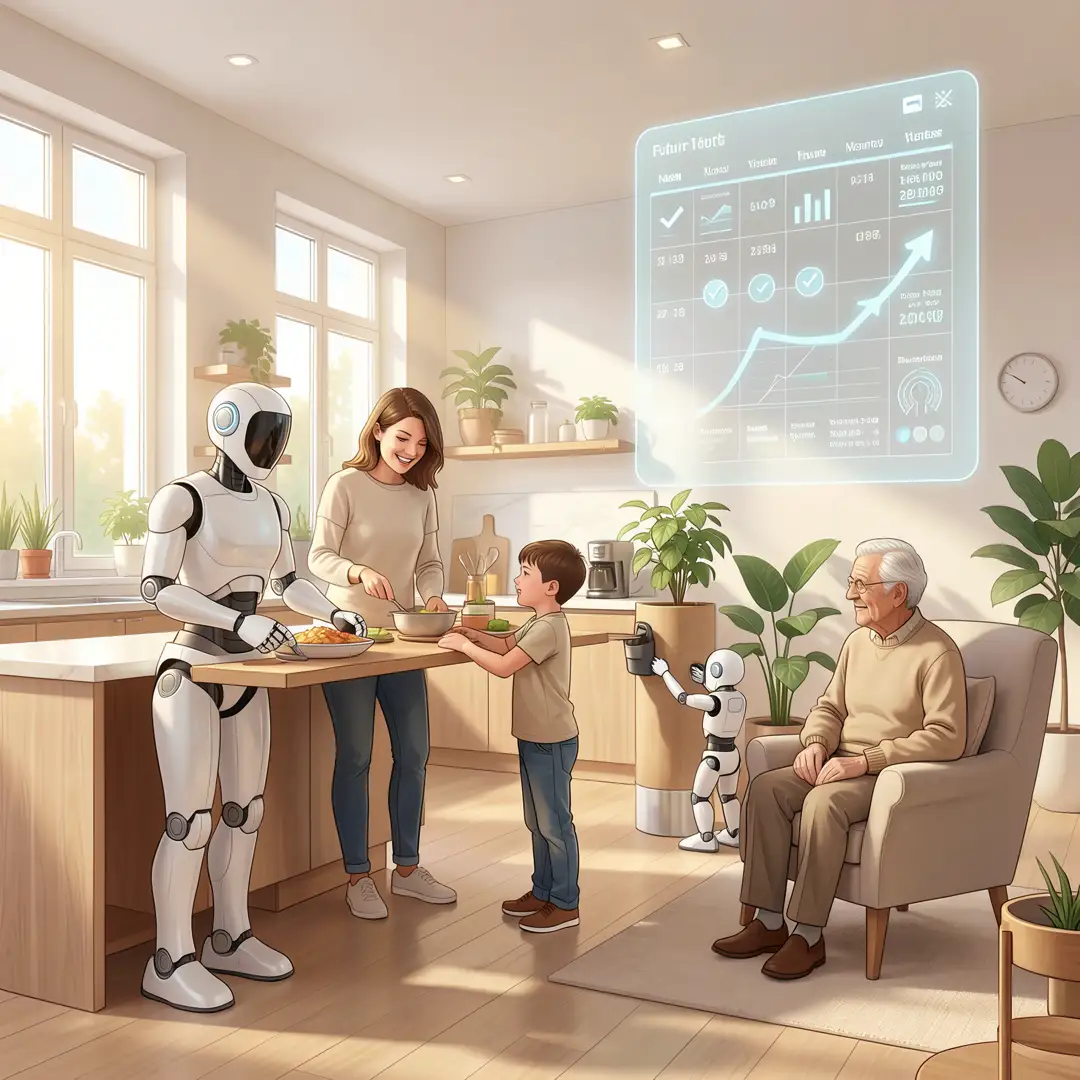
Home robots already succeed at single, repetitive tasks: vacuuming, mopping, lawn mowing, and pool cleaning. The next wave aims at multi-step chores — loading a dishwasher, sorting recycling, or fetching items for someone with limited mobility. The technical barrier is manipulation in cluttered, unpredictable spaces. The social barrier is trust: people must feel safe letting a machine move around their kitchen. Expect adoption to grow first among older adults who value independence and among busy households willing to tolerate occasional mistakes.
Workplaces
Warehouses and factories lead because their environments are structured. Mobile robots already transport goods; robotic arms already weld and package. Office and retail settings will follow more slowly. A hospital delivery robot that carries medications between floors is realistic today. A robot that restocks shelves in a chaotic convenience store is much harder. The pattern is consistent: structured environments automate first, unstructured ones later.
Public spaces
Sidewalk delivery robots, security patrol bots, and cleaning machines in airports are expanding. Their success depends less on hardware and more on regulation, insurance, and public acceptance. Cities will decide where robots may operate, how fast they can move, and who is liable when something goes wrong.
What changes for you
Three shifts matter most. First, robots will become more affordable and more specialized. Second, they will generate large amounts of data about your home or workplace, raising privacy questions you should answer before purchase. Third, they will change job tasks rather than simply eliminating jobs — routine physical tasks shrink while oversight, maintenance, and exception-handling roles grow.
Understanding the fundamentals of The Future of Robotic Assistants in Everyday Life helps you make informed decisions because it lets you match the technology to the task. A robot that is mediocre at ten things is usually worse than a robot that is excellent at one.
Best Practices
Use these habits to get value from robotic assistants without wasting money or creating new problems.
- Start with a real pain point. Buy or deploy a robot because a specific, recurring task drains your time or energy — not because the technology is novel.
- Check the autonomy level honestly. If a robot needs constant human help, factor that time into your decision.
- Read the privacy policy before the spec sheet. Cameras and microphones collect data. Know where it goes and whether you can disable it.
- Plan for maintenance. Batteries degrade, sensors fog, brushes wear out. Budget time and money for upkeep.
- Keep humans in the loop for safety-critical tasks. Never rely on an unproven robot for medication, child care, or security without oversight.
- Update firmware promptly. Security patches matter more for internet-connected robots than for simple appliances.
- Measure outcomes, not novelty. Track hours saved, errors reduced, or satisfaction improved. If those numbers do not move, adjust.
Step-by-Step Guide
Follow these six steps to adopt robotic assistants thoughtfully, whether at home or at work.

Step 1: Understand the fundamentals
Learn the vocabulary covered in the Key Concepts section. Know the difference between autonomy levels, understand what perception and manipulation mean, and recognize that embodiment imposes physical limits. This foundation lets you ask sharp questions of vendors and avoid overpaying for capabilities that do not exist yet. Spend an hour reading independent reviews and watching demonstration videos — not just promotional clips.

Step 2: Assess your starting point
Inventory the tasks you want help with. For each one, note how often it occurs, how long it takes, how physically demanding it is, and how much variation exists. A task that happens daily, takes an hour, and varies little is a strong candidate. A task that happens rarely and changes every time is a poor candidate. Also assess your environment: floor types, clutter, stairs, Wi-Fi coverage, and the people or pets who share the space. Robots succeed in predictable settings.

Step 3: Set clear goals
Write down what success looks like. Examples: “Reduce time spent vacuuming from three hours a week to thirty minutes” or “Cut order-picking errors by half within six months.” Goals should be specific, measurable, and tied to a real outcome. Avoid vague aims like “use more AI.” Clear goals keep you from chasing features you will never use and give you a baseline for evaluation later.
Step 4: Gather necessary resources
Identify what you need before you buy or deploy. This includes budget for the device plus accessories and repairs, space for charging and storage, reliable internet if the robot depends on cloud services, and time for setup and learning. At work, add staff training, a point person for maintenance, and any safety or compliance approvals. If a required resource is missing, the deployment will stall.

Step 5: Apply the core methods
Start small. Run the robot on a limited schedule in a limited area for two to four weeks. Observe how it performs, where it fails, and how people react. Adjust the environment — move cables, label zones, set no-go areas — rather than expecting the robot to adapt instantly. Train users on basic operation and emergency stop procedures. Keep a simple log of issues and fixes. The goal is to reach a stable routine before expanding scope.

Step 6: Monitor your progress
Review your goals against actual results monthly. Track the metrics you defined in Step 3, plus secondary signals like user satisfaction and maintenance costs. If the robot is saving time and working reliably, expand its role gradually. If it is not, diagnose whether the problem is the task, the environment, or the device — and be willing to stop. Reliable information and consistent habits lead to better long-term outcomes than enthusiasm alone.
FAQ
What should I know about The Future of Robotic Assistants in Everyday Life?
You should know three things. First, adoption will be gradual and uneven — structured environments automate before messy ones. Second, today’s useful robots are specialists, not general-purpose helpers, so match the machine to a specific recurring task. Third, privacy and safety deserve as much attention as performance. Understanding the fundamentals of The Future of Robotic Assistants in Everyday Life helps you make informed decisions instead of following hype.
Who is this guide for?
This guide is for anyone who wants a clear, practical framework for evaluating robotic assistants. That includes homeowners considering a service robot, older adults exploring tools for independent living, managers evaluating workplace automation, and students or curious readers who want to understand where the technology is heading. No technical background is required — just a willingness to assess tasks, set goals, and measure results.
Will robots replace human workers?
Mostly they will change tasks rather than eliminate whole jobs. Routine physical work — moving goods, cleaning floors, inspecting equipment — is most exposed. Roles that involve judgment, empathy, and handling exceptions will grow in importance, often alongside robots rather than in competition with them. The practical response is to build skills in oversight, maintenance, and human-robot collaboration.
How much should I expect to spend?
Consumer robots range from around a hundred dollars for a basic vacuum to several thousand for advanced models with manipulation or autonomous navigation. Workplace deployments cost far more once you include integration, training, and maintenance. Set a budget that includes the device, accessories, repairs, and your own time. A cheaper robot that fails constantly is more expensive than a reliable one.
What are the biggest risks?
Privacy tops the list, because cameras and microphones collect data about your home or workplace. Safety is second — a moving machine can injure.
You now have a solid foundation for The Future of Robotic Assistants in Everyday Life. Apply the best practices above and revisit this guide as your needs evolve.